
Every generation of students faces unique hurdles in learning and homework. Today’s students are no different, even though their homework and learning experiences are far more advanced than those of previous generations.
In terms of technological development, today’s challenge is unique and unprecedented. It isn’t a new way to solve a tricky math problem; it’s the sneaky instant text box of an AI chatbot. AI homework help vs. real comprehension is the hurdle this generation’s students are facing.
From drafting essay outlines to solving equations and summarizing history chapters, AI tools produce polished schoolwork. For families, the payoff is clear: smoother evenings, easier assignments, and strong grades. But a question remains. Did the student master the material, or did AI do the heavy lifting?
At GradePower Learning, we see how technology shapes student learning every day. While tech is here to stay, relying on AI for homework can mask learning gaps—gaps that often don’t surface until a student faces an unassisted assignment, test, or exam.
The Difference Between Task Completion and Cognitive Growth
To see how leaning on AI homework help for quick answers affects development, it helps to look at how the brain builds lasting skills. True learning isn’t about the finished worksheet—it’s about the mental effort students take to get there.
True learning isn’t about the finished worksheet—it’s about the mental effort required to get there. Deep comprehension moves through four distinct stages:
- Information input: Taking in new concepts and instructions.
- Cognitive friction: Grappling with the problem and working through uncertainty.
- Schema formation: Connecting new ideas to what the brain already knows.
- Active retention: Locking that knowledge into long-term memory.
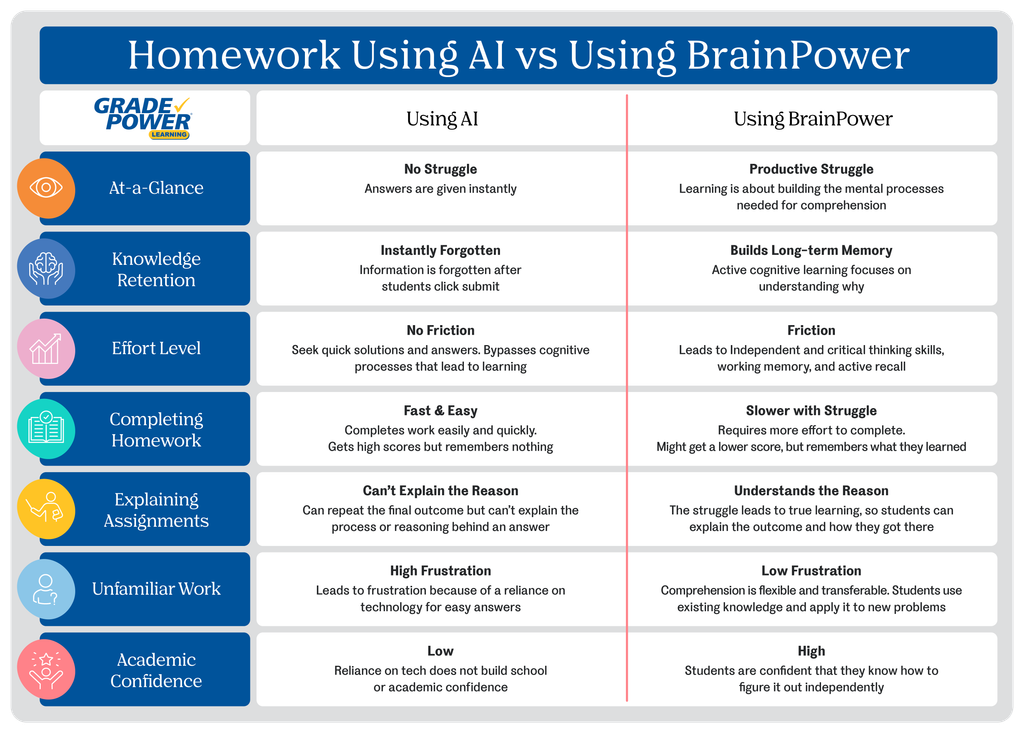
When a student works through a tough word problem, their brain experiences productive struggle. The struggle is the moment when they build critical thinking, working memory, and active recall. Using AI tools removes that friction. By delivering the final answer instantly, they skip the very stage where real learning happens.
AI-assisted homework prioritizes speed and passive recognition, meaning students forget information the moment they hit “submit.” Without that foundational effort, test readiness suffers the second technology is taken away. Active problem-solving, on the other hand, builds resilient, lasting mastery.
Three Warning Signs AI Is Masking a Learning Gap
How can you tell if AI has quietly shifted from a helpful study aid to an academic crutch? Watch for these three common red flags:
- The Kitchen Table vs. Classroom Disconnect: Students breeze through homework at the kitchen table and earn high marks on daily assignments, yet their quiz and test scores tell a very different story. That gap between take-home work and in-class performance often points to missing foundational skills that only surface when tech support is not present.
- An Inability to Explain the “Why”: When students cannot explain a completed essay or assignment without looking at their screen, it points to a lack of understanding. If they can read the finished answer aloud but stumble when you ask why they chose a particular approach—or what a specific formula actually means—they’ve likely generated the work without truly internalizing the concept.
- Growing Frustration with Unfamiliar Problems: When a test phrases or formats a question slightly differently from what they practiced with AI, your child hits a wall. Genuine comprehension builds mental flexibility; relying on instant answers leaves students stuck the moment the rules or conditions change.
Moving Beyond Quick Fixes to Build Independent Thinking
AI tools aren’t going away, and the goal isn’t to ban technology—it’s to make sure it never replaces active thought. True academic confidence doesn’t come from getting the right answer faster; it comes from knowing how to figure things out when you aren’t sure where to start.
At GradePower Learning, our programs focus on metacognition—teaching students how to think, not just what to memorize. By strengthening reading comprehension, logical reasoning, and executive functioning skills, we equip students with the tools they need to succeed independently in the classroom and beyond.
If you suspect your child is relying on quick answers to mask deeper frustration, our comprehensive Student Learning Profile can pinpoint the exact skills that need support—before test scores start to slip.